Fever in children: when and how to bring it down, with doses by weight
When to treat a child's fever, paracetamol and ibuprofen doses by weight in mg and ml, what not to do and when to call 103.
- Medications
- First aid
- Baby Care
- Cold and Flu
On this page
The short answer: give a fever medicine when your child is uncomfortable, not just because of the number on the thermometer. The two main options for children are paracetamol (from 3 months, 10–15 mg/kg every 4–6 hours, no more than 4 doses and 60 mg/kg a day) and ibuprofen (from 3 months and 5 kg, 5–10 mg/kg every 6–8 hours, no more than 30 mg/kg a day). If a baby under 3 months has a temperature of 38 °C or more, see a doctor straight away.
When to bring a temperature down
A fever is a temperature of 38 °C or more. It's the body fighting an infection, and in children it usually settles within 1–4 days. A fever medicine doesn't treat the infection: it makes your child more comfortable so they can drink, sleep and rest.
- If your child is playing, drinking and seems fine with a fever, medicine isn't required.
- If they are listless, irritable, not drinking or can't sleep, give a fever medicine: what matters is how your child is, not a particular number on the thermometer.
- If a doctor has given you separate instructions for your child (for example, because of a long-term condition), follow them.
- Fever medicines don't prevent febrile seizures, so don't give them "just in case".
How to take a temperature properly
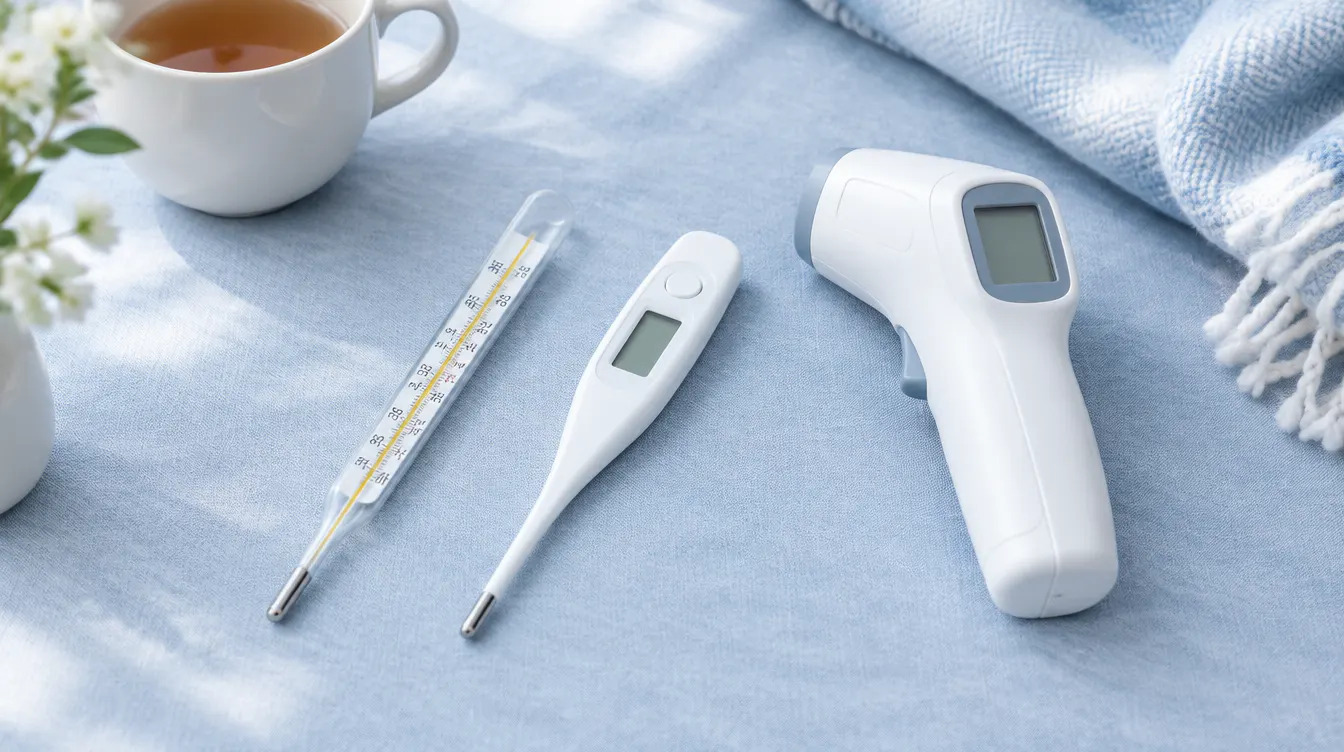
- Use a digital thermometer under the armpit. It works at any age, and for babies under 1 month it's the only recommended method.
- The armpit should be dry. Place the tip deep in the armpit, hold the arm against the body and wait for the beep.
- For children over 1 month, an infrared ear thermometer also works. Forehead strips and feeling the forehead by hand aren't accurate.
- Don't measure straight after a bath, a feed or active play: wait 20–30 minutes.
- Mouth and rectal readings aren't routinely used in young children.
- A mercury thermometer is dangerous if it breaks: switch to a digital one.
For help choosing one, see "How to choose a thermometer".
Paracetamol or ibuprofen
Both bring a temperature down and ease pain well. Pick one. If it doesn't help, you can switch to the other one next time.
| Paracetamol | Ibuprofen | |
|---|---|---|
| Who can take it | from 3 months (at 2–3 months only on a doctor's advice) | from 3 months and at least 5 kg |
| Single dose | 10–15 mg/kg | 5–10 mg/kg |
| How often | every 4–6 hours, no more than 4 times a day | every 6–8 hours, usually 3 times a day |
| Daily maximum | 60 mg/kg | 30 mg/kg |
| Without a doctor, no longer than | 3 days | 3 days (24 hours at 3–6 months) |
| Take care with | liver or kidney disease; never with other medicines containing paracetamol | avoid with chickenpox or dehydration (vomiting, diarrhoea, not drinking); with asthma, kidney disease or a stomach ulcer, ask a doctor first |
Paracetamol for children: what it's for, which form and how much
Paracetamol brings a temperature down and eases pain, such as a sore throat, earache or teething, but doesn't treat the cause (an infection). The dose is always based on your child's weight: 10–15 mg/kg per dose, every 4–6 hours, no more than 4 doses and no more than 60 mg/kg a day.
- Syrup or suspension, 120 mg/5 ml — from 3 months (at 2–3 months only on a doctor's advice). Measure it with the oral syringe; the table below gives the ml.
- Suppositories — if your child is vomiting, refuses syrup or is asleep. Choose the strength by the weight on the pack; don't use them with diarrhoea.
- Tablets — for older children who swallow tablets easily; check the leaflet for age and weight. A 500 mg tablet is for adults and teenagers of 40 kg or more, not small children.
Syrup and suppositories are the same paracetamol: their doses add up. Without a doctor, give it for 3 days at most. If your child may have had too much, call 103 at once, even if they seem fine.
Paracetamol dose by weight (120 mg/5 ml syrup)
The children's paracetamol syrups in our pharmacies are 120 mg/5 ml, which means 24 mg in each ml. Ages are approximate, so work out the dose by weight.
| Weight | Approx. age | Single dose | 120 mg/5 ml syrup | Daily maximum |
|---|---|---|---|---|
| 5 kg | 3–4 months | 50–75 mg | 2.5–3 ml | 300 mg (12.5 ml) |
| 8 kg | 6–9 months | 80–120 mg | 3.5–5 ml | 480 mg (20 ml) |
| 10 kg | 1 year | 100–150 mg | 4.5–6 ml | 600 mg (25 ml) |
| 12 kg | 1.5–2 years | 120–180 mg | 5–7.5 ml | 720 mg (30 ml) |
| 15 kg | 3 years | 150–225 mg | 6.5–9 ml | 900 mg (37.5 ml) |
| 20 kg | 5–6 years | 200–300 mg | 8.5–12.5 ml | 1200 mg (50 ml) |
| 25 kg | 7–8 years | 250–375 mg | 10.5–15.5 ml | 1500 mg (62.5 ml) |
| 30 kg | 9–10 years | 300–450 mg | 12.5–18.5 ml | 1800 mg (75 ml) |
Leave at least 4 hours between doses and give no more than 4 doses in 24 hours. Measure with the oral syringe from the pack, not a teaspoon. If your syrup is 250 mg/5 ml, work out the volume as mg ÷ 50 = ml.
Ibuprofen dose by weight (100 mg/5 ml suspension)
Children's ibuprofen suspension contains 20 mg in each ml. The table follows the Nurofen for Children leaflet. Ibufen and Ibuprofen Aktiv have the same strength, but always check the table in your product's own leaflet.
| Weight | Age | Single dose | 100 mg/5 ml suspension | Times a day | Daily maximum |
|---|---|---|---|---|---|
| 5–7.6 kg | 3–6 months | 50 mg | 2.5 ml | up to 3 | 150 mg (7.5 ml) |
| 7.7–9 kg | 6–12 months | 50 mg | 2.5 ml | 3–4 | 200 mg (10 ml) |
| 10–16 kg | 1–3 years | 100 mg | 5 ml | 3 | 300 mg (15 ml) |
| 17–20 kg | 4–6 years | 150 mg | 7.5 ml | 3 | 450 mg (22.5 ml) |
| 21–30 kg | 7–9 years | 200 mg | 10 ml | 3 | 600 mg (30 ml) |
| 31–40 kg | 10–12 years | 300 mg | 15 ml | 3 | 900 mg (45 ml) |
Leave 6–8 hours between doses. If your child has a sensitive stomach, give it with food. If the suspension is a "forte" 200 mg/5 ml one, the volume is half, and check the leaflet for its age limit.
- Nurofen suspension 100 mg/5 ml strawberry 100 ml
- Ibufen suspension 100 mg/5 ml 100 ml
- Ibuprofen Aktiv suspension 100 mg/5 ml 100 ml
Suppositories: when they help
Paracetamol suppositories help when a child is vomiting, refuses syrup or is asleep. Choose the strength by the weight on the pack: for example, Cefecon-D 100 mg is for 7–10 kg and 250 mg for 17–30 kg. Don't use them with diarrhoea. Suppositories and syrup are the same paracetamol: keep 4 hours between them and count both towards the daily total.
- Cefecon-D suppositories 100 mg ×10
- Cefecon-D suppositories 250 mg ×10
- Efferalgan children's suppositories 150 mg ×10
What not to do
- Never give aspirin (acetylsalicylic acid) to children under 16. It can cause Reye's syndrome, a serious condition affecting the liver and brain. Check the ingredients of cold and flu powders too.
- Don't give paracetamol and ibuprofen at the same time, and don't alternate them unless a doctor advises it: it's easy to get the doses wrong.
- Don't give two medicines containing paracetamol together (for example, syrup and a suppository at the same time, or syrup and a cold and flu powder).
- Don't rub your child with alcohol, vodka or vinegar. Alcohol is absorbed through the skin and can poison a child, and vinegar irritates the skin. Cold wraps, ice and cool baths aren't needed either: shivering only pushes the temperature up.
- Don't bundle your child up or strip them completely: light clothes and a thin blanket are enough.
- Don't give the next dose early or go over the daily maximum, even if the temperature is slow to come down.
- Only give metamizole (analgin) or other medicines if a doctor prescribes them.
What helps without medicine
- Offer small drinks often: water, or breast milk for a breastfed baby.
- Offer food if your child wants it, but don't force them.
- Air the room and let your child rest.
- Check on them during the night too.
- Keep them home from nursery or school while they have a fever.
Febrile seizures
Some children aged 6 months to 5 years have a seizure (fit) during a fever. It's frightening, but usually brief. Lay your child on their side on a flat surface, don't put anything in their mouth, don't hold them down, and note the time. Call 103 straight away if it's the first seizure, if it lasts longer than 5 minutes or if your child has trouble breathing.
When to see a doctor or call 103
Call 103 straight away if your child has:
- a seizure;
- a rash that doesn't fade when you press a clear glass against it;
- a stiff neck, discomfort from light, or a bulging soft spot (fontanelle);
- severe drowsiness, is hard to wake, is confused, or cries constantly in an unusual way;
- difficult, very fast or grunting breathing;
- pale, blue or blotchy skin or lips, or cold hands and feet;
- possibly had too much medicine, even if they seem fine.
See a doctor the same day if:
- your baby is under 3 months and has a temperature of 38 °C or more;
- your baby is 3–6 months old and has a temperature of 39 °C or more;
- there are signs of dehydration: a dry mouth, no tears when crying, sunken eyes, far fewer wet nappies, a sunken fontanelle;
- your child isn't drinking or keeps vomiting;
- the fever lasts more than 3 days on medicine, or 5 days or more in total;
- your child is getting worse, or you're worried.
Frequently asked questions
At what temperature should I bring a child's fever down?
There is no single number. NHS and NICE advise giving a fever medicine when the child is distressed, not just to bring the temperature down. If they are listless, irritable, not drinking or can't sleep, give paracetamol or ibuprofen. If your child is playing and drinking with a fever, medicine isn't required. If a doctor has given you separate instructions for your child, follow them.
Can I give paracetamol and ibuprofen together or alternate them?
Not at the same time. Alternate only if a doctor advises it. Start with one medicine. If it doesn't help, you can switch to the other one next time, keeping to each medicine's interval and daily maximum.
What if the temperature doesn't come down after the medicine?
The medicine starts to work in 30–60 minutes, and the temperature often doesn't drop all the way to normal. That's fine. Don't double the dose or give the next one early. If your child seems worse or has any of the warning signs below, see a doctor or call 103.
Which is better: syrup or suppositories?
Syrup is easier to dose accurately and usually works faster. Suppositories help when a child is vomiting, refuses syrup or is asleep. Don't use them if the child has diarrhoea. Remember that paracetamol syrup and paracetamol suppositories are the same medicine, so the doses add up.
Why dose by weight rather than age?
Children of the same age can weigh very differently, and the safe amount depends on weight. If you don't know the weight, use the age table on the pack, and never go above the leaflet maximum.
Sources
- NHS: High temperature (fever) in children
- NHS: Paracetamol for children
- NHS: Ibuprofen for children
- NICE NG143: Fever in under 5s: assessment and initial management
For other cold remedies, see "Cold and flu: what to keep in your home medicine cabinet".
This article doesn't replace advice from a doctor. Questions? Ask the pharmacist at any ABAPharm pharmacy or write to us in the site chat.
More articles
Health and wellbeing
Probiotics with antibiotics: when they help and how to take them
When antibiotics are really needed, why they cause diarrhoea, which probiotics have the best evidence (S. boulardii, L. rhamnosus GG) and how many hours after the antibiotic to take Linex, Enterol or Enterogermina.
Child Care
Ear pain in children: what to do at night and when to see a doctor
Why a child's ear hurts, what to do right now and at night, when ear drops are safe, whether an ear infection needs antibiotics, what not to do and when to get help urgently.

Cold & Flu
Antivirals for flu: what actually works
Which flu antivirals have strong evidence and which don't: a comparison table on Tamiflu (oseltamivir), Arbidol, Ingavirin, Kagocel, Ergoferon and interferons, who should see a doctor on day one, and what helps everyone.